Sunday, April 26, 2015

Chapter 52 - Archetypal Model Revisited


In January of this year, I made a posting called "Archetypal Model" to the Kundalini Consortium Site. In this posting, I presented a well-known Eastern archetypal model of the subtle body. At the time of my kundalini rising in late 2005, this model was instrumental in giving me a framework to understand what was happening in order to integrate these changes into a life that was experiencing a major renovation and restoration.

This model can be reviewed in detail by re-reading the previous posting, but a summary is provided here.


The invisible subtle body lies beyond all that represents our solid physical bodies but is interconnected with it. It is made up of three diaphanous sheaths:

1. Energy sheath is partially made up of energy channels that intersect six major chakras. These chakras can be associated with the physical body’s nerve plexuses and gland system.

2. Mental sheath consists of the conscious and unconscious mind broken down into three aspects: chitta or the unconscious storehouse of past impressions and imprints; manas or the sensory motor mind which carried out and responds to bodily functions, impulses etc.; and the ahankara or ego which create all our boundaries, self-definitions, and self-concepts, our sense of I-ness.

3. Discernment sheath, our reflective consciousness or higher mind often referred to as the voice of reason.
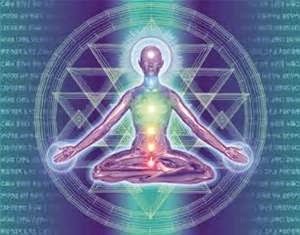


This archetypal model provided a visual representation that helped me to understand and integrate this very unusual phenomenon of Kundalini as it carried out its life changing agenda over a period of many months turning into years.

The purpose of this posting is not to review what has already been discussed, but to complete this Archetypal model for a portion not covered in the previous posting.

To complete the picture, we must add one further extension. Just as the Physical Body ends with the skin and then the Subtle Body begins, the Subtle Body ends with the discernment sheath and then the “Casual Body” begins.

What is this “Casual Body”? Other terms that could be used to describe it are the celestial realm, pure consciousness or pure essential reality. It is the place where one has moved beyond false and limited identification with the transitory world of illusion, beyond space and time, beyond phenomena, beyond dualism.


The first three sheaths described in the January posting could be presented and understood on a logical basis. That’s why at that time I choose to end it there. These three sheaths represented the areas of consciousness where I noticed most of the renovation and restoration process taking place. In the energy sheath, I experienced the opening of the energy channels and chakras and the many physical and psychological symptoms that resulted from their opening. In the mental sheath, I experienced a collapse in my previous world view as kundalini energy influenced and modified chitta with its past imprints and impressions, unresolved issues, drives, parental and church injunctions. As it moved into ahankara, I experienced what seemed like hitting the immovable wall of the ego, and a dismantling of its self-constructs, self-definitions, boundaries and unconscious attachments. In the discernment sheath, I experienced the observer, looking on, surrendering and submitting to all that was happening.

The movement to the Casual Body cannot be as easily explained, but there is a story which speaks of it to me.
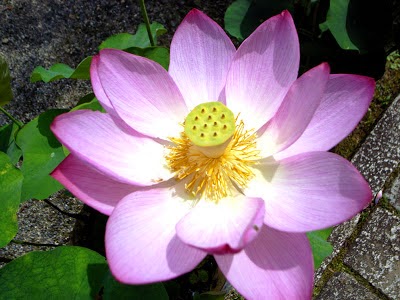


"It is said that the Buddha loved all sentient beings with a love of a father for his children. But the children did not listen to their loving master. Though there was wealth in their own outer house, they did not want it, and instead they went running around outside in confusion. All the master could do was to sew a jewel into each of their garments so that when they were impoverished and starving, they might discover it themselves and be rich in ways they would not otherwise expect. This was the master’s tender compassion and love

What is this own outer house? It is our physical bodies, sprung from our parent’s union. It is that place made up of our form, sensitivities, concepts, syntheses and consciousness, born of time and space, with the appearance of permanence but fleeting. What is this garment? It is the Casual Body. Inside it is the precious jewel. In Chinese Taoism, they speak of using the false to cultivate the real. Without the outer house, there would be no way to find the real. But this real is an inner secret.

The door to the Casual Body is opened when we recognize the impoverishment and emptiness of all that precedes it. Our physical form, and even our subtle bodies with all of its kundalini activity is constantly changing. There’s nothing permanent about it. The same is true with every aspect of our sensibilities. They provide a window to the world as we see it, but they are empty of any sort of permanence. All of our conceptions of reality are only constructs of what we have inherited or assumed. They are constantly changing as our views change. Even events like birth and death are only moments in time, the beginning when physical form takes shape, and then changes and dissipates. All such syntheses built into our lives are constantly in a state of change. And finally, our consciousness or awareness, our ability to discriminate is constantly changing and therefore empty of permanence.

We use what is false to discover what is real, and the real is the jewel hidden in the garment. And the real cannot be spoken about because it is beyond the comprehension of the intellect; beyond what can be described in words.
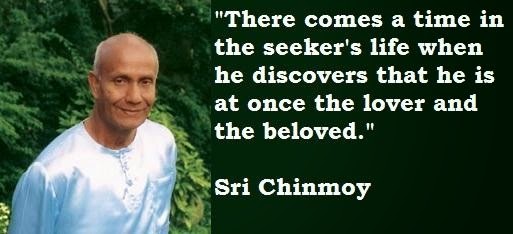


Revelation

No more my heart shall sob or grieve.
My days and nights dissolve in God's own Light.
Above the toil of life my soul
Is a Bird of Fire winging the Infinite.


I have known the One and His secret Play,
And passed beyond the sea of Ignorance Dream.
In tune with Him, I sport and sing;
I own the golden Eye of the Supreme.

Drunk deep of Immortality,
I am the root and boughs of a teeming vast.
My Form I have known and realized.
The Supreme and I are one; all we outlast.
From “My Flute by Sri Chinmoy

Monday, April 13, 2015

Chapter 51 - A Zen Allegory

In China, there exists nine paintings which allegorically describes the human search for one’s “true self”.  By reflecting on these paintings, we are able to trace our own journey to realization.  This is particularly true to those who have experienced Kundalini Rising, the internal force that not only renovates the subtle body system, but restores one to a wholeness that is beyond ordinary comprehension.  With these paintings, I share my own journey.  Through your own reflection, you are invited to create your own story

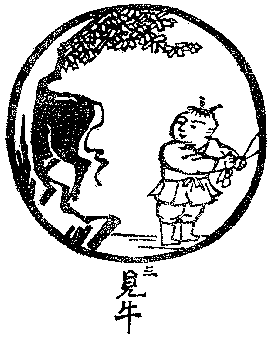
The man to whom the Ox belongs is standing, looking all around in the thick forest.  He cannot see where the Ox is gone.  He is simply bewildered, confused.  It is getting late and the sun is setting.  Soon it will be night.  Then going into the thick forest will become more difficult.

For many years, my life was a sum total of the external events that made it up.  Work, study, dating, marriage, family, trips, career moves, entertainment, etc.  There was little of turning inward to discover a life that may lay within.  An idea of such an inner life was largely absent.  Everything that I wanted could be found externally.  This is where happiness and success could be found.  But something was missing.  How come all these external things, goals and successes did not measure up, and provide the happiness that I thought they would?


The man finds footprints for the ox. Maybe the Ox can be found. He follows them.  

I felt like my inner light was being suffocated out.  I needed to change something in my life to counter this feeling of emptiness and failure.   The books I've been reading speak of an inner life that is just as important as all these exterior things.  Others have suggested getting involved in some community activities; maybe a prayer group, or some meditation.  My wife has suggested that I need to be more open in sharing what I am feeling, not to keep it all bottled up inside.  Where does one begin?  Have to start somewhere.

The man sees the shadow of the Ox far off in the thick forest.  It’s hard to make out. 

The recommended meditation time is twenty minutes, twice a day, morning and night.  I’ll start with twenty minutes in the morning.  Back straight, eyes closed, be silent and still, repeat a word and give it my full attention.  Coordinate this with my breath.  If I drift off into thought, I come gently back to my word.   There are moments when I do experience an inner connection.   I surrender to these inner movements.  I learn to love my meditation time.  But when I’m not meditating, everything again gets blurry and confusing.  But I seem to be a bit more peaceful.


The man reaches the Ox.  He can see the Ox more clearly now.  There’s more internal rejoicing.

I’m now meditating twice a day.  Who would ever believe that meditation could have such an affect.  I even enjoy sharing my meditation experience with others, and some I even invite to the groups I attend.   The authors of those meditation books I've read are describing what I am actually experiencing.  I have started to attend some meditation retreats.  They really get me in touch with that “inner presence”.  At times, I even experience the stillness of an inner observer listening and looking out at all the crazy things going on around me.  Sometimes I seem to be absorbed completely into a shining lake of light, and it's ecstatic.


The man holds the Ox by its horns, puts a halter on it, and struggles to lead it towards home.

I am doing meditation retreats quite frequently, sometimes seven days.  After a few days, I am able to move into deep penetrating meditation, and I have this feeling of the old person falling away and this new person comes to the center.  At times like this, I feel like I’m really living the life that I am intended to live.  I would like to move away from all those exterior things that keep me so busy, but unfortunately, I have responsibilities.  But when I return home after a retreat, I often slip back to where I was before, or so it seems.  All my old constructs and boundaries seem to return and reassert themselves.  I’ll just have to try harder.  Maybe speak to someone.


The man rides on the back of the Ox as they continue towards home.

Something extraordinary happened.  I decided to go on an extensive meditation retreat, and on the thirty-eight day, I had this experience of an energy at the base of my spine rising up through my body to the top of my head. I was filled with light.  It wasn't painful, but very ecstatic and even erotic.  So many changes are happening I can’t keep up with them.  It’s like the flow of this energy is changing everything.  Sometimes I feel like the whole world as I knew it before has collapsed and something new is coming into being, something better. 

The man ties the Ox down in its place. And waits.

This whole kundalini experience is very liberating, but also a little confusing.  I need time to understand and integrate this experience.  I’m doing a lot of reading, writing, meditating.  I’m beginning to take yoga to get grounded, to strengthen my body, and to learn more about what is happening to me.  I’m trying to deal with all these physical and psychological changes.  It seems like all the old constructs and boundaries have gone or changed.


The man is so full of joy that he starts playing on his flute.

What I had been searching for all these years was there all the time.  I just had to discover it.  Not only that.  What I was searching for was really the true me all the time.  What I now experience interiorly is what I now see and experience exteriorly.  It’s like I am beginning see everything the way it really is.  It’s like the old me is gone, and a new more wholesome me has come in its place.


An Empty Frame of the new man and Ox

No more constructs.  No more images or models.  No more cosmologies.  No more Buddha.  No more Christ.  No more clouds.  Clear sky.  The enjoyer is the very source of the enjoyment.   The seeker and the sought are one.


"The light of spiritual awareness, shining alone, far removed from sense faculties and sense objects, revealing in its essential body true eternity, not confined to words, detached from false objects.  This is Pure Essential Reality."
Pai-chang

Sunday, March 15, 2015

Chapter 50 - Kundalini - Not An End In Itself


I am moved by the story of Lo-pu who asked:  “How is it when the morning sun has already risen but the night moon has not yet appeared?  He is told that this is a meditative accomplishment.  You sit in meditation and forget both body and mind, and there is just this single brilliant expanse of light.  It is as if the sun has already come out but the night moon has not yet appeared.  At night, it is not the same.  This light is pure and cool.

The Taoist classic, “The Triplex Unity” says: perfect yang is “brilliant”, and perfect yin is “reverent”.  After yin culminates and yang is born, when body and mind share the same root with heaven and earth inside and outside, and it’s a single light, this is the realm of “perfect yang is brilliant”.

At this point you have already gone beyond the issue of whether the ch’i channels are open or not.  When you talk of the three channels and seven chakras, you have not even reached the first stage of Samadhi.  When Lo-pu reached the stage expressed in “when the sun has already risen but the night moon has not yet appeared”, he had already transcended the state of Samadhi. 

Lo-pu is told: “The dragon carries the ocean pearl in his mouth, paying no attention to the fish swimming by.” There is something here.  In the single expanse of light that is both inside and outside, it seems that a dragon is swimming through the ocean, and in his mouth he is holds a bright pearl.  This bright pearl is the dragon’s root of life (reverent).  Fish are swimming by on all sides, but the dragon does not even glance at them or look their way. 

If you cultivate the ch’i channels properly and recite the mantra properly, and your cultivation reaches the point where there is just this moment of mindfulness, you too will be the same as the dragon carrying the ocean pearl in his mouth, paying no attention to the fish swimming by.  You will be paying no more attention to all those false thoughts around you in whatever form they may take. 

As you do your meditation work, no matter whether it is by refining the breath or reciting the mantra, or any other method, all you have to do is to hold onto that moment of mindfulness, and focus your mind on one object without letting it move; and remember: “The dragon carries the ocean pearl in his mouth, paying no attention to the fish swimming by.”  Slowly, you too will be able to reach this realm.
Adapted from Master Nan Huai-Chin’s book “Working Towards Enlightenment”.

I’ve always intuitively felt that Kundalini was never meant to be an end in itself, but a means to something more.  What is that something more?  It could be that which is expressed above in the story from Master Nan Huai-Chin’s book; reaching for that realm where, as a single light, body and mind share the same root with heaven and earth inside and outside.  This is a book on Buddhist thought, and this is a Buddhist story. It explains to me my own experience.  But I don’t believe it has to be Buddhist.  My experience of “ the dragon carrying the ocean pearl in his mouth, paying no attention to the fish swimming by” originates from a Christian context.  But I don’t believe it has to be Christian.

"The kingdom of heaven is like a treasure hidden in the field, which a man found and hid again; and from joy over it he goes and sells all that he has and buys that field. Again, the kingdom of heaven is like a merchant seeking fine pearls, and upon finding one pearl of great value, he went and sold all that he had and bought it."
Gospel of Matthew

From my reading and my understanding, I believe that kundalini like child birth belongs in the scientific or biological realm.  But just as child birth, for some, is seen as an unfolding of a mystical or spiritual event, so too, for some, kundalini is seen as an unfolding of a mystical or spiritual event.  When the perfect yin, that which is reverent (celestial) is combined with the perfect yang, that which is brilliant (free from all distractions), something new emerges that is beyond the activity of kundalini.  And from this new emergence, something new again is probably beginning to take shape.    


One of the principal obstacles to this ever-ending expansion, I believe, is getting stuck at any one stage.  Each step on this pathless path requires a letting go or surrendering of what was previous experienced in order to embrace what is new.  As I have so many times, it’s easy to get stuck.  

Friday, November 21, 2014

Chapter 48 - Creating a Worldview

In previous chapters (21 to 24), I noted some of my observations on the subject of "Worldview". I am now sharing further insights on this subject taken from Deepak Chopra's book "Life After Death" (which I have recently read). I have left out a few of Dr. Chopra's illustrations in order to fit this material into this limited space. 

Creating a World View - Deepak Chopra
When two worldviews clash, as Western culture is clashing
with radical Islam, the pressure to cling to one worldview or the other against outside threat is inescapable.  Our very survival is said to depend upon it.  I am reminded of a CNN interview with a right-wing Christian operative from Indiana who said: "As long as liberals and atheists despise us, we will never go away.

Two people with different worldviews can see the same fact and give totally divergent interpretations of it, because no fact or event is perceived by itself.  Walking down the street, I may pass a woman with bright red lipstick, a faint whiff of wine on her breath from lunch, and no hat on her head.  In my worldview, none of these facts triggers any particular emotion or judgement, so this is a neutral encounter that barely registers on me.  Therefore you might assume that nothing happened in my brain.  Yet, a great deal happened tacitly.  The sight of this woman entered my brain as raw data along the optic nerve, but I couldn't actually "see" her until that data passed through my worldview.  Imagine a series of filters marked "memory", "beliefs", "associations", and "judgments".  Each filter alters the raw data in some way, invisibly and instantaneously.

Should a person with a different worldview encounter the same woman, he would "see" her through his filters.  If he happened to be a traditional Muslim or a Victorian or a medieval monk, all the innocuous features that entered my brain -- the lipstick, the smell of alcohol, the absence of a hat --might cause a violent reaction in his brain, and generate considerable stress.

A worldview provides fixed grooves for behavior, which is dangerous, unfortunately, much of the time.  Traits like racism and war-making persist as automatic reflexes. 

Anatomically the human nervous system is divided into two parts: the somatic and autonomic nervous systems.  All
information in the body that you are conscious of comes from the somatic nervous system; all information that you are unconscious of comes from the autonomic nervous system. Memes occupy a fascinating middle ground, a shadowland. When you can't get a catchy song out of your head -- one classic example of meme behavior  -- you are totally conscious of the tune, but unconscious of why you can't get rid of it.  You may be completely aware that you have a certain trait, such as being stingy, irritable, easily flattered, or self-important, but you cannot say why that trait sticks to you, however much you dislike it.

Worldviews are built of symbols that fulfill a need.  By whatever name we give them, memes are the way we give meaning to experience.  They package meaning into the building block of reality.  Insofar as we are creators of reality, we use these symbolic building blocks as our raw material.  

The Vedic rishis had their own model for what happened in the mind field.  "Thought forms" that grip us are samskaras, impressions made on the nervous system by past experiences.  A young child frightened when his mother forgetfully left him in a department store might carry that impression, or samskara, for life.  Such impressions do not have to be negative. A first kiss can, and usually does, form a lasting samskara.  The concept of samskara goes beyond memes because it applies to all mental experiences. Whether they are sensations, desires or ideas, impressions can go as deep into the field as the soul.  They constitute the qualities of the self that give each of us an identity we recognize as me. 

Samskaras can be dismantled or changed only by affecting
the right level of the mind.  A change at the subtlest level is the most powerful.  "The highest form of human intelligence is to observe yourself without judgement-Krishnamurti" That is, if you can stand aside from how your beliefs are behaving, how various impulses of desire and repulsion are pulling at you, how the "stored consciousness" of memory makes you see the world, you can witness the field itself. This is true enlightenment.  In many spiritual traditions, the key seems to be stillness, detaching oneself from the internal dialogue whose stream of ideas and impulses comes from the past.  Witnessing allows us to see and understand with an intelligence that is holistic, without a win-or-lose orientation.  This gives us a chance to experience the mine field, or what we popularly call "having an open mind'.

The most profound of contradictions is that to reach enlightenment, which is free from past impressions, you have no choice but to use your brain, and the brain is mired in its habits of filtering, choosing, preferring, rejecting, etc.  "Can a fragmented mind ever experience wholeness"?  The answer is that it cannot, but all any of us are equipped with is a fragmented mind, a mind made up of memes and samskaras.  Asserting that you have an open mind while someone else's mind is closed or claiming that you experience reality instead of illusion, seems like a reasonable statement, but which are the pure Vedanta -- it is impossible to do things like "trying to be more open" or "trying to get more real".  You are simply fighting with your own divided self.

So what is the way out of this paradox?  There is a way to approach the tricky business of opening your mind.

1.  Know that you are going to identify with your worldview at every stage of personal growth.

2.  Accept that these identifications are temporary.  You will never be truly yourself until you reach unity.

3.  Be willing to change your identity every day.  Take a flexible attitude.  Don't defend an "I" that you know is just temporary.

4.  Allow your ability to quietly observe without judgement to replace the ingrained ideas you reach for automatically.

5.  When you have the impulse to struggle, use that as an immediate signal to let go. Open a space for a new answer to unfold on its own.

6.  When you can't let go, forgive yourself and move on.

7.  Use every opportunity to tell yourself that all viewpoints are valid, every experience valuable, every insight a moment of freedom.
From:  Life After Death - Deepak Chopra


Monday, November 17, 2014

Chapter 47 - Why We Perceive Heaven Differently

As one who has come from a Christian tradition, my perception of heaven has been influenced by many variables such as Biblical stories, Biblical images, Biblical concepts, Christian dogma, teachings etc.  

Through meditation, what I experience "now" of heaven, however is very different and changing as I am  immersed into silence, stillness, and the simplicity of the practice.   Deepak Chopra describes this changing reality in his book, "Life after Death".  

Three worlds: A Map of Eternity

1.  Consciousness of physical objects:  This is the world of concrete things that we verify through the five senses.  It obeys linear time.  We appear to ourselves as physical bodies separated in time and space.  A life span occupies a limited number of years between two absolute events, birth and death.

The laws obeyed in this dimension are strict.  Gravity, the speed of light, and the conservation of matter and energy (which can be neither created nor destroyed) form the foundation of every other natural law.

If this is your primary world, you have certain powers that allow you to explore it.  These include physical strength, willpower, reason, emotional expression, sexuality, and personal authority.  To the extent that you use these powers fully, you will be more and more successful.  At the same time, you are most likely to become attached to this dimension of consciousness as the only reality.

In this world Akasha feels like physical space filled with an infinity of material things.

The soul feels personal but is seen only in short glimpses.


2.  Consciousness of subtle objects:  This the world of dream, imagination, and inspiration in all its many forms. We verify this world through intuition, detecting qualities like love and beauty, feeling a subtle presence within and without that is not available to the five senses.  A life span in this dimension lasts as long as it can be imagined.

The laws of the subtle world are fluid. Events can happen forward or backward.  Invisible structures may persist for a long time (for example, as myths and archetypes) but even then, time doesn't bind them as strictly as in the physical world.  Gravity and the speed of light are no longer absolutes.

If this is your primary world, you will have certain powers that allow you to explore it.  These include imagination, memory, artistic abilities, spiritual sensitivity, healing abilities, and intuition.  The more you exercise these powers, the more successful you will be.  However, you may also find yourself detached from the physical world and unable to navigate it will as someone without intuition and spiritual sensitivity. This will worry you until you discover that the subtle world is capable of supporting you.  

Akasha feels dreamlike, filled with memories and images, archetypes and gods, spirits and etheric beings. 

The soul feels like a guiding force leading back to the source. It is sensed constantly.


3.  Pure Consciousness:  This is the world of awareness being aware of itself.  There are no objects, gross or subtle.  We verify this world through "I Am".  Existence becomes its own end, its own reward.  As an experience, pure consciousness begins with a silent mind; this grows in richness and meaning the longer a person has the experience.

The laws of this world apply to creation itself.  The seeds of every object and event gestate here.  Here is the possibility of time, space, and physical things. There is also the possibility of mind, as yet without thought of images.  Although totally free of anything visible, pure consciousness is eager to give birth; mystics tell us it is pregnant with "All That Is".

If this is your primary world, you need no powers to navigate it. The flow of time and the expansion of space are neutral events to you; they come and go within your being.  You witness them without attachment, although if you wish, you can call upon any quality -- love, compassion, strength, truth -- and experience it in fullness.

In this world, Akasha feels uncreated.  Concepts like birth and death, life and death, have no relevance.  There is only existence.  To be is an all-enveloping experience.

It must always be kept in mind that the afterlife is not as "after" as we assume.  All three dimensions of consciousness are ever-present space.  

Akasha enclosing the world of physical objects is three-dimensional.  Our eyes can survey the landscape to tell us where we are.  Up and down are fixed directions to orient us physically.  Before and after are fixed points in time to orient us to where we are in our lifetimes.

Akasha enclosing the world of subtle objects has much vaguer boundaries.  These can change in an instant to free-floating dream-space.  In the absence of fixed dimensions, experience is measured in terms of intensity.  Emotions are heightened, dreams become more vivid, and the presence of angels and other etheric entities is felt directly.  With experience, this becomes a comfortable space on its own terms, as it already is for artists, intuitives, and deeply spiritual people.

Akasha enclosing itself is pure existence.  It feels incredibly secure because there is unity with everything.  Any experience comes from within, a single point from which creation emanates like an energy beam or a flower opening infinitely.

The soul is impersonal.  It is "Being", with no added qualities.

From: "Life After Death" by Deepak Chopra

Saturday, October 12, 2013

Chapter 37 Kundalini's Restorative Energy

One of the most outstanding psychiatrists in America was Dr. Carl Rogers.  He spoke of developing our personalities by moving beyond the responses we have developed from our past life-experiences.  For him, deep down in each of us is the innermost self.  This core of personality is basically healthy and positive, basically society oriented. By plunging down into your innermost self in silence, you make contact with God as healer.  As long as you live superficially (noisy and fragmented) in a world of ever-increasing multiplicity and meaninglessness, you will not know the health of body, soul and spirit that God wishes you to enjoy.
George Maloney SJ

Since my kundalini rising in the fall of 2005, I have been relatively free from the effects of ego consciousness as it
relates past life's experiences.  By past life's experiences, I
mean the events that have happened in the past that have led to a conditioned behavior; suppressed feelings and hurts, strict adherence to restrictions and rules imposed on me as a child or early adulthood, etc. The problem with such things is that they would often trigger a compulsive response or reaction to a situation over which I had little control or awareness. Kundalini energy successfully renovated and restored the subtle body system which for the large part, eliminated most of these uncontrolled compulsive responses. 

That's not to say that I no longer struggle with ego
consciousness.  I do. I can still experience anger, frustration and confusion about many issues that crop up in my life. As these new situations occur, particularly if they are in conflict with some of my deeply rooted principals, my mind can easily turn to judgement, criticism, and at times blaming. I generally know when this happens because I immediately sense a dis-ease within myself, and a loss of my of harmony with the offending person, and a loss of a sense of union with the Divine within.

The methods that I have and am pursuing with this ongoing re-dominating ego consciousness are different from the methods that I would have used in the pre-kundalini past.  The
remedies that I would have used in the past were either to stay for a time in an attitude of self-righteous judgement, condemning the action of others as unjust and deserving of my wrath, or undertaking a mental examination on the issue in order to look at the situation objectively, and hopefully arrive
at a more fitting and gentle conclusion.  This involved the work of serious reflection, analyzing my response, speaking with others, coming to terms with the issues, reconciling the situation in my mind, letting go of my judgement, and seeking forgiveness for myself and the other if I had reacted negatively towards them. Then I would be able to set the issue aside and get on with things.  There's nothing wrong with this approach.  It is called an examination of conscience, and is a healthy way to move beyond contentious issues and arrive at an acceptable and peaceful conclusion.      

With the rise of Kundalini energy, I find that this rather lengthy and onerous task of personal examination of conscience is no longer as necessary.  As I do my practices to keep the subtle body open, the flow of energy from the base chakras (root, sacral and solar plexus) advances up the spine to the crown and places me in union with the "One" beyond "self", and restores my inner being to the acceptable and peaceful conclusion that could previously only be attained through the more intense analytical approach.

Kundalini practices seem to continue the flow of restorative
energies into areas of the mental sheath where the ego attempts to retain or regain dominance. This flow of restorative energy to the crown brings one to the state-of-being of "observer" of the negative events, and "healer" of the critical and judgemental mind.  In this way, it is possible to regain quickly that connection and union with the divine.  George Maloney refers to it as a plunging down into your innermost self in silence to make contact with God as healer. 

Future subjects:
Kundalini practices 
What makes up ego consciousness


Wednesday, October 2, 2013

Chapter 36 The Freedom We All Seek

"That which the yogis seek does not serve their own purpose.  In fact, as long as we have our own purpose, we cannot really be open to higher and sacred purposes.  The whole meaning of yoga can be understood as progressive freedom from the hindrances that impede our availability to the purpose of supra personal intelligence.  The major hindrance is what we usually call our ego or "self", as long as it serves its own ends, it cannot serve the ends of the real "Self".
Ravi Ravindra - "The Spiritual Roots of Yoga"

As I read Ravindra's book on "Yoga The Royal Path To Freedom", I am drawn to its truth, and how it personally speaks to me through my own experience of Yoga and the transforming power of Kundalini energy.  Although, through my Christian faith, I believe that Grace is necessary to make the necessary steps towards "dying" to self in order to enter the power and presence of Christ, we can facilitate the power of Grace through our practice of the eight limbs of Yoga. 

Kundalini, with its ecstatic blissful flow of exuberant energy, keeps us steadfast on the path, gives us the motivation for our journey, and fills us with God's delightful Presence.


All of this must never to done to serve our own purpose, because our own purpose accentuates the "ego" which then becomes the impediment to the whole process. 

What purpose must be always kept in the forefront? 


 As Ravindra points out: The end must be the holiness of the "Real Self", the Divine within.

St. Ignatius begins his spiritual exercises with the following
prayer which speaks of the same reality. He calls it "The First Principle And Foundation".
We are created to praise, reverence, and serve God our Lord, and by this means to save our souls.
The other things on the face of the earth are created to help us in attaining the end for which we were created.
Hence, we are to make use of them in as far as they help us in the attainment of this end, and must rid ourselves of them in as far as they prove a hindrance.

Therefore, we must make ourselves indifferent to all created things, as far as we are allowed free choice and are not, under any prohibition.  Consequently, as far as we are concerned, we should not prefer health to sickness, riches to poverty, honor to dishonor, a long life to a short life.  The same holds for all other things.
Our one desire and choice should be what is more conducive to the end for which we are created.

What St. Ignatius is saying in respect to his spiritual exercises is similar to what Ravindra is saying in respect to the Yogis and their spiritual practice.  As long as we are driven by our own purpose, that is the purpose of "ego", then the freedom that we seek will never be available to us.  The "ego" is the very cause of the slavery from which we are trying to escape. 

What does the "ego" seek?  Health versus sickness, riches versus poverty, honor versus dishonor, long life versus short life.  Ego is caught up in the world of those things we are attracted to or repulsed by, and as long as we are driven by our attractions and those things that repulse us, we remain caught in this web of our own purpose.  It is only in our "holy indifference" that we can escape this self-made prison and enter that reign where subject/object relatedness disappear.

Such a transition to this new reign is not possible through use of the "self".  In fact our "self" is a contradiction to the "selflessness" we seek because it continues to get into its own way.


Kundalini is the energy that breaks this attachment to the illusionary "self", cuts through years of conditioning, and allows us to enter into relatedness as "I AM". 


The Christian surrenders to Christ through Grace to experience this Oneness with His Spirit.  "I live now, not I, but Christ lives in me."